ADVANCED HYPNOTHERAPIST TRAINING
Take Your Hypnosis Skills to Practitioner Level. Online Only.
Learning an induction is one thing.
Understanding why you are using it, where the session should go next and how to adapt to the person in front of you is another.
Advanced Hypnotherapist Certification – Volume 1moves beyond foundation hypnosis into advanced practitioner development.
You'll study emotional mechanics, immersive hypnosis, Subconscious Navigation, Instinct Field Situational Awareness, advanced deepener construction and a structured 16-State Session Architecture designed to take you beyond simply reading scripts.
The aim isn't to create script readers. It's to develop practitioners.
🟧 Buy Volume 1
🟧 View Certification Training
That distinction comes directly from the training: students are expected to analyse behavioural patterns, identify emotional mechanisms, make practitioner decisions, design interventions, construct hypnotic sequences and apply them to client situations.
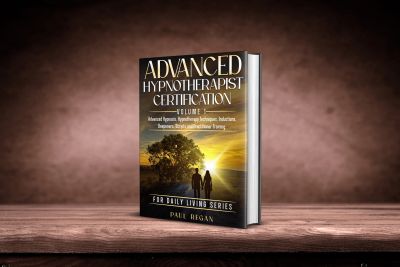
Go Beyond Scripts. Learn to Think Like a Practitioner.

Is This You?
Ready to Move Beyond Basic Hypnosis?
Perhaps:
- You've already learned hypnosis fundamentals.
- You understand inductions and deepeners.
- You can follow a hypnosis script but want to understand what lies behind it.
- You want to construct your own sessions.
- You want to understand emotional and behavioural patterns.
- You want more advanced approaches to hypnotic immersion.
- You want to become more adaptable with different clients.
- You want structured practitioner training rather than another collection of scripts.
- You're interested in developing hypnosis as part of a professional wellness practice.
- You want to progress towards advanced hypnotherapist certification.
If you're ready to move from learning hypnosis to learning how to think like a practitioner, this is the next stage.
Why Basic Hypnosis Can Only Take You So Far
A traditional hypnosis structure might look like:
Induction → Deepener → Suggestion → Return
That's useful.
But advanced practitioner work requires understanding what is happening between those stages.
What emotional state is the client bringing into the session?
What behavioural pattern sits underneath the presenting problem?
What happens when conscious narration returns?
When should you deepen?
When should you stabilise?
What should replace the existing emotional state?
How do you bring someone safely back into ordinary awareness?
Volume 1 expands the session beyond a simple four-part structure and teaches the practitioner to think about the complete journey.
The Instinct Field Hypnosis Method
Learn the Architecture Behind the Session
Volume 1 introduces the advanced structure of the Instinct Field Hypnosis Method.
Rather than relying on isolated techniques, you learn how different components can work together:
Emotional Architecture
↓
Hypnotic Access
↓
Immersive Environment
↓
Instinct Field Situational Awareness
↓
Subconscious Navigation
↓
Emotional Exchange
↓
Behavioural Installation
↓
Reintegration
The objective is to understand the architecture well enough to begin adapting it to different people, environments and behavioural objectives.
The 16-State Session Architecture
A Complete Framework for Building Advanced Sessions
At the centre of Volume 1 is a structured 16-State Architecture:
- Orientation State
- Access State
- Stabilisation State
- Disruption State
- Immersion State
- Recursive Instability State
- Operational Focus State
- Transitional Descent State
- Chaos-to-Calm State
- Signal Contact State
- Allowance State
- Exchange State
- Temporal Integration State
- Identity Stabilisation State
- Behaviour Installation State
- Reintegration State
Students don't simply read the stages. The certification work requires state recognition, sequencing and session-architecture exercises.
What You'll Learn
✔ Advanced hypnosis session construction.
✔ Emotional mechanics and behaviour formation.
✔ Somatic recognition.
✔ Emotional saturation.
✔ Conscious narration and internal interference.
✔ Environmental simulation and immersion.
✔ Instinct Field Situational Awareness.
✔ Subconscious Navigation.
✔ The 16-State Session Architecture.
✔ Emotional Exchange systems.
✔ Identity stabilisation.
✔ Behavioural installation.
✔ Future integration.
✔ Practitioner observation.
✔ Advanced deepener construction.
✔ Safe reintegration.
✔ How to adapt rather than simply recite hypnosis scripts.
✔ How to analyse client presentations and construct structured session pathways.
Volume 1 is deliberately built around developing practitioner thinking, progressing from conceptual understanding into application, intervention planning, emotional architecture and complete session construction.
Understand Emotional Architecture
Look Beneath the Presenting Behaviour
Clients don't arrive as blank pages.
They arrive carrying:
Emotion. Anticipation. Stress. Behavioural patterns. Internal dialogue. Physical tension. Previous experiences.
Volume 1 teaches you to look beneath the surface presentation and begin recognising how emotional processes can influence behaviour.
The training uses two recurring behavioural profiles:
Mr X
Representing patterns including operational overload, emotional suppression, anticipation, emotional fatigue and performance-related stress.
Mrs X
Representing patterns including emotional saturation, looping, self-monitoring, social sensitivity and emotional anticipation.
You repeatedly return to these profiles throughout the training to practise analysing behaviour and selecting appropriate practitioner responses.
The Emotional Exchange Matrix
Change Doesn't Always Mean Jumping to the Opposite Emotion
Someone experiencing anxiety doesn't necessarily need to jump immediately to extreme confidence.
Someone experiencing grief doesn't simply need to be told to become happy.
Volume 1 introduces the Emotional Exchange Matrix, teaching you to consider safer transitional states.
Examples from the framework include:
Anxiety → Calm Stability
Panic → Regulation
Shame → Self-Acceptance
Emotional Numbness → Reconnection
Grief → Warmth
Overthinking → Presence
Rejection → Self-Worth
Exhaustion → Recovery
Hopelessness → Possibility
Social Fear → Safety
Identity Collapse → Stabilisation
The framework then distinguishes regulation, functional, expansion and higher-risk emotional states to help students think about emotional progression rather than crude emotional replacement.
Go Beyond Relaxation
Hypnosis Is More Than Becoming Relaxed
Volume 1 makes an important distinction between relaxation and state navigation.
Relaxation can reduce tension.
Advanced state navigation is concerned with what happens after access has been created.
The training therefore explores structured subconscious experiences, environmental immersion, emotional processing and behavioural conditioning rather than treating hypnotic depth itself as the final goal.
Depth Is the Access Point. The Journey Is the Work
Build Immersive Hypnotic Environments
The environment becomes part of your practitioner toolkit.
Instead of every session taking place on the same imaginary beach or staircase, you'll learn to construct and work with different immersive environments.
Volume 1 explores:
Tunnel & Corridor Systems
Tunnel drift, endless corridors, expanding distance and dimensional passage.
Elevator & Descent Systems
Vertical descent, mechanical deepening, floor-based emotional access and level transitioning.
Transport & Journey Systems
Trains, underground systems, moving vehicles and environmental transition.
Urban Instability Systems
Crowds, sirens, public tension, blackouts, negotiation rooms and public-disorder environments.
The point isn't simply creating an interesting visualisation.
You learn to think about why that environment is being used and what function it performs within the hypnotic journey.
For Daily Living Hypnosis Services

Learn Through Real Practitioner Applications
Theory Becomes Useful When You Can Apply It
Volume 1 doesn't leave the concepts isolated from real situations.
Throughout the book, advanced sessions and applications are built around recognisable problems and environments, including areas such as:
Divorce & Separation
Social Anxiety & Fear
Workplace Burnout
Fear of Rejection
Career Uncertainty
Financial Pressure
Recovery After Arguments
Sales Confidence & Rejection
High-Pressure Performance
The objective is not simply to copy these sessions.
It's to examine their construction, understand the modules being used and eventually develop your own practitioner approach.
Learn to Construct. Not Just Copy
That's why the training is modular.
A practitioner needs to be able to recognise what is happening and make decisions.
Volume 1 encourages students to examine individual script sections, adapt and expand them, and develop their own delivery style rather than treating scripts as fixed pieces of text.
Learn the structure. Understand the purpose. Adapt the delivery.
This Is a Workbook . Not Just a Textbook
This is where the positioning becomes particularly strong.
You're not simply reading 500+ pages and reaching the end.
Exercises throughout the programme ask you to:
- Analyse behavioural patterns
- Identify emotional mechanisms
- Evaluate practitioner decisions
- Construct hypnotic sequences
- Design interventions
- Build immersive environments
- Apply concepts to client scenarios
- Reflect on practitioner choices
- Develop session architecture
The exercises become progressively more advanced as you move through the programme.
Work Towards Advanced Certification
Instinct Field Advanced Hypnotherapist Practitioner, IFAHP
Volume 1 forms the first half of the advanced certification programme.
The complete IFAHP award requires:
Advanced Hypnosis Volume 1
Advanced Hypnosis Volume 2
Workbook Exercises
Case Studies
Practical Assessment
Final Written Examination
The qualification is therefore not awarded simply for buying or reading the book.
A Real Assessment Pathway
The complete pathway includes a substantial assessment structure.
Students are required to complete case studies covering areas including anxiety, confidence, behaviour change and emotional regulation, alongside a student-selected case study. The programme also specifies a 60-hour practitioner logbook divided between self-practice, peer practice, observed practice and case-study practice.
The final assessment includes:
50 Multiple-Choice Questions
20 Short-Answer Questions
Scenario Assessment
Complete 16-State Session Design
and practical assessments including:
20-Minute Induction
20-Minute Deepener
20-Minute IFSA Immersion
20-Minute Subconscious Navigation
Full 60-Minute Session
The manuscript specifies a 70% pass threshold, with higher bands for Merit and Distinction.
Safety, Ethics & Practitioner Responsibility
Advanced Technique Requires Advanced Responsibility
The certification pathway includes dedicated work around:
Informed Consent
Client Safety
Reintegration
Practitioner Boundaries
Referral Procedures
Ethical Practice
Students are required to demonstrate their understanding rather than merely read about it, including completion of an ethics paper within the full programme.
The objective is not simply learning how to take somebody deeper.
It's learning how to observe, adapt and bring them safely back.
Discover the Power of Hypnosis with For Daily Living

Why This Training Is Different
There are plenty of hypnosis courses that can teach you:
An induction.
A deepener.
A suggestion script.
This programme asks you to go further.
Why this induction?
Why this environment?
What emotional architecture are you working with?
What should happen next?
How will you recognise when something changes?
How will you adapt?
How will you reintegrate the client safely?
By the end of Volume 1, the book describes the student as having explored subconscious immersion, environmental deepening, destabilisation, situational awareness, sensory absorption, emotional architecture, behavioural regulation, identity stabilisation and subconscious navigation.
The goal isn't deeper trance for the sake of deeper trance.
The goal is better practitioner understanding.
Who Is This For?
This programme is designed for:
- Hypnotists ready to progress beyond foundation training
- Hypnotherapists wanting a more structured advanced framework
- Wellness practitioners adding advanced hypnosis skills
- Coaches with appropriate hypnosis training
- Practitioners interested in emotional and behavioural processes
- People who want to construct rather than simply read scripts
- Students progressing through the Instinct Field practitioner pathway
- People considering hypnosis as part of a wider wellness practice
This is not the starting point for somebody who has never learned hypnosis.
Students should already understand hypnosis fundamentals, inductions, deepeners and ethics. The programme recommends Learn Hypnosis and Self-Hypnosis as the preceding training, while the certification wording also allows an existing hypnotherapy qualification as prerequisite evidence.
Your Training Pathway
Start With the Foundations
Learn Hypnosis & Self-Hypnosis
Learn hypnosis foundations, inductions, deepeners, scripts, session structure and self-hypnosis.
↓
Advanced Hypnotherapist Certification Volume 1
Build the architecture.
Develop advanced state navigation, emotional architecture, immersive environments, deepener systems and practitioner thinking.
↓
Advanced Hypnotherapist Certification Volume 2
Continue into the deeper practitioner applications and complete the advanced training pathway.
Volume 1 explicitly ends by directing the learner into Volume 2, which builds on the architecture and systems established here.
About the Author
Paul Regan is the founder of For Daily Living and developer of the Instinct Field training ecosystem.
His work brings together hypnosis, Subconscious Navigation, Instinct Field Situational Awareness, emotional regulation, behavioural development, performance and wellness-based training.
Advanced Hypnotherapist Certification Volume 1develops the practitioner architecture underlying the advanced Instinct Field Hypnosis Method.
Transform Your Life with For Daily Living
Frequently Asked Questions
Can I start with Volume 1 if I've never studied hypnosis?
No. This is advanced training. Students should already understand basic hypnosis, inductions, deepeners and ethical practice. Learn Hypnosis and Self-Hypnosis provides the preceding foundation route.
Do I become certified by buying the book?
No. The book is part of the training pathway. The IFAHP award requires both advanced volumes together with the required workbook, case-study, practical and examination components.
Is Volume 2 required?
Yes. Volumes 1 and 2 are both required for completion of the advanced certification pathway.
Does Volume 1 contain practical exercises?
Yes. Exercises are integrated throughout the workbook and progress from understanding concepts into analysis, intervention planning and complete session construction.
Will I learn advanced deepeners?
Yes. Volume 1 includes dedicated systems involving tunnels, corridors, elevators, journeys, transport and urban environments.
Is this just another hypnosis script book?
No. Scripts are included, but the stated purpose of the workbook is to develop practitioner thinking rather than simply produce people who read scripts.
What qualification does the complete pathway lead to?
Successful completion of the complete requirements leads to the Instinct Field Advanced Hypnotherapist Practitioner (IFAHP) award from the Instinct Field Training Academy, according to the certification structure set out in the book.
Ready to Move Beyond Basic Hypnosis?
You've learned how to hypnotise.
Now develop the skills to understand what happens next.
Learn to assess.
Learn to construct.
Learn to observe.
Learn to adapt.
Learn to build complete hypnotic journeys rather than simply reading somebody else's words.
Stop Following the Script. Start Thinking Like a Practitioner.
🟧 Buy Advanced Hypnosis Volume 1
🟧 Start the Advanced Certification Pathway
This is a particularly strong page for the site because it gives us a clear commercial ladder: Learn Hypnosis brings beginners in, Volume 1 moves them into advanced practitioner training, and Volume 2 completes the advanced pathway.